Mbamba Swamp 3rd July
This place is conveniently located to avoid the city of Kampala. The Airport is at Entebbe which is not far from the swamp.
Most birding tours start their tour with this main site (after perhaps an introduction in Entebbe Botanical Gardens) and so did we.
The chances of seeing the Shoebill are high and probably nowhere better in the world elsewhere.
Since it is not far from the Airport it is a good idea to start your trip with this boat tour.
If you miss it you have another chance when you get back from your trip.
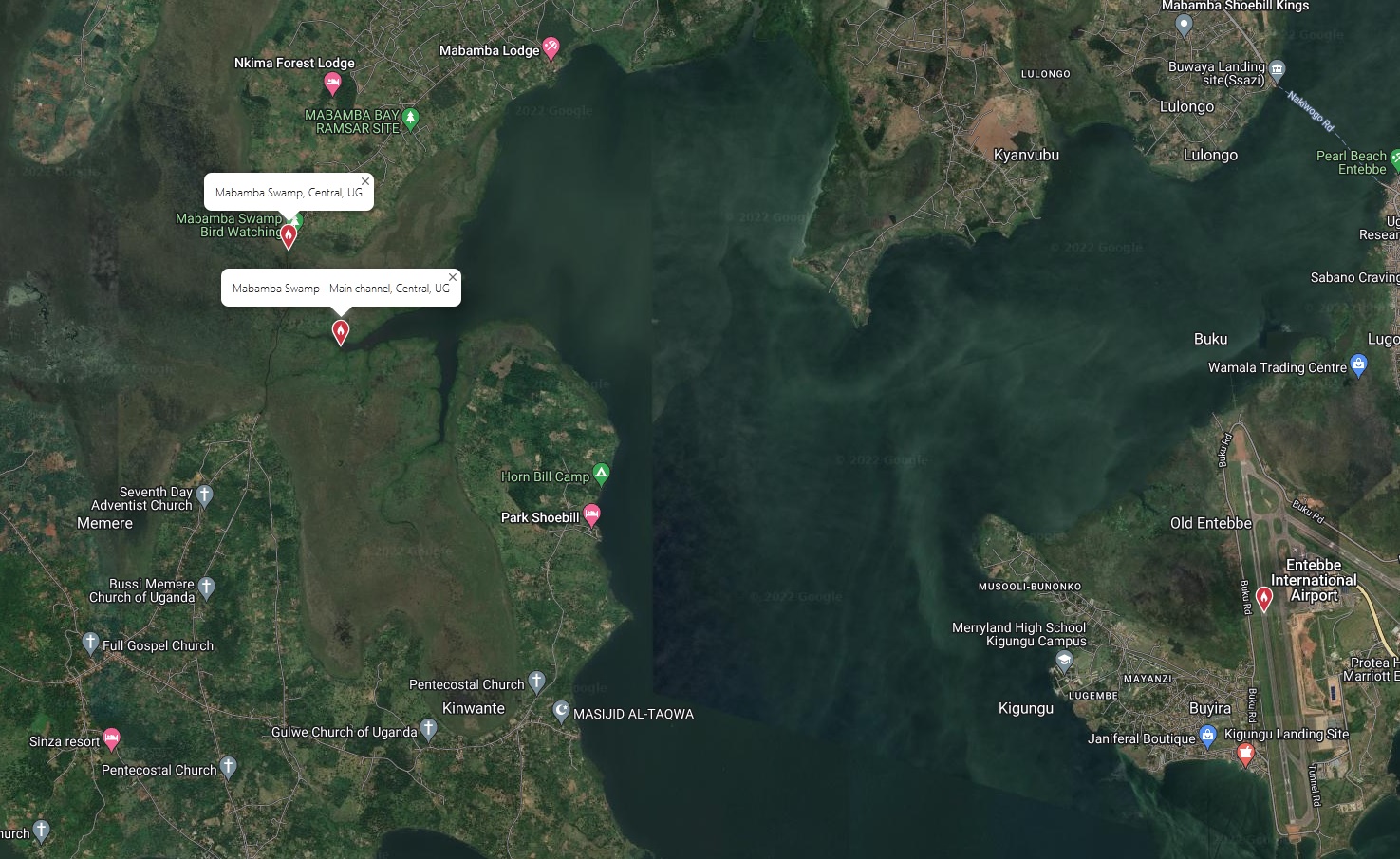
We arrived and fairly quickly boarded the boat to the main channel and soon started seeing good birds:
https://ebird.org/checklist/S115245566
Soon we saw our first Shoebill and it was very close to us.

On our way to Mburo we stopped at a few good sites which were well known to our guide Abia.
We tried at several places to find some papyrus specialists, among them Papyrus Gonolek. Abia knew that Bigodi Swamp is a site where it can be seen
but that place has a lot of birders and the bird has been "overtaped". The best place we stopped was Bukoto Marsh where quite a few good birds were seen.
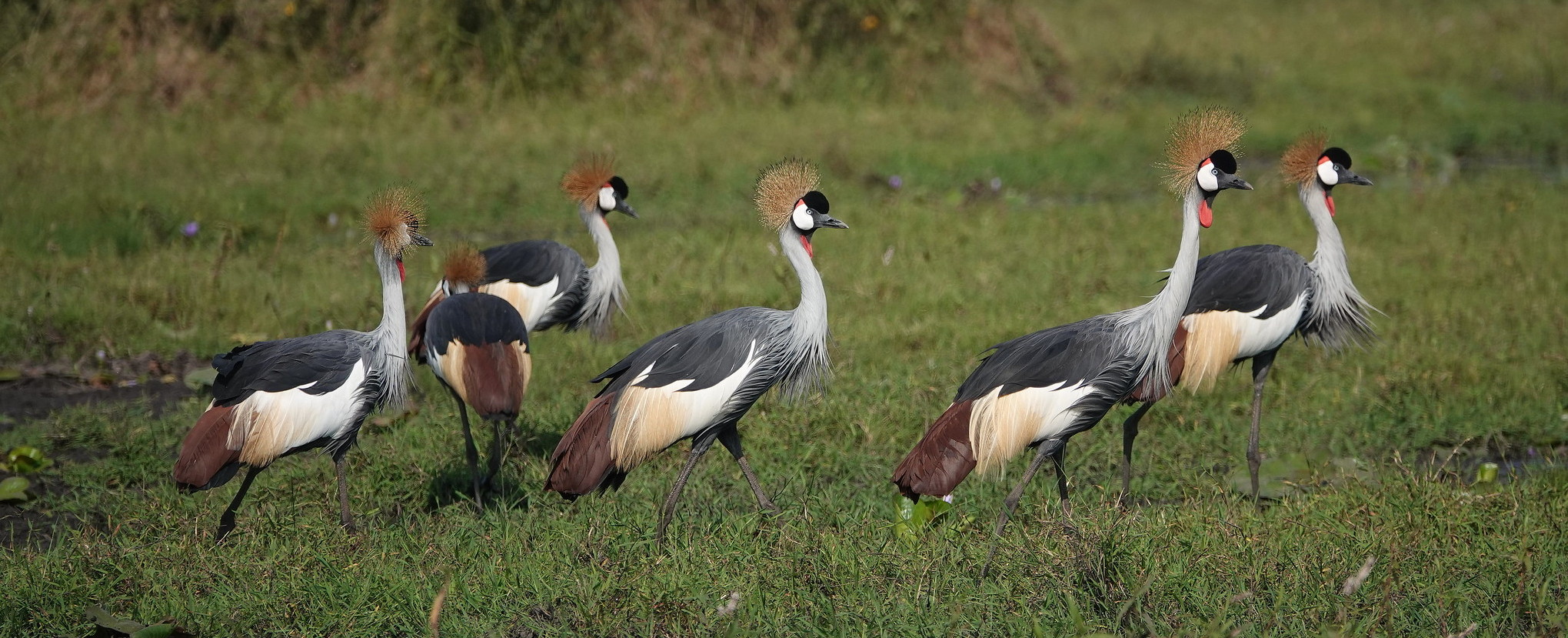
Birds recorded in this good area where:
https://ebird.org/checklist/S115258583
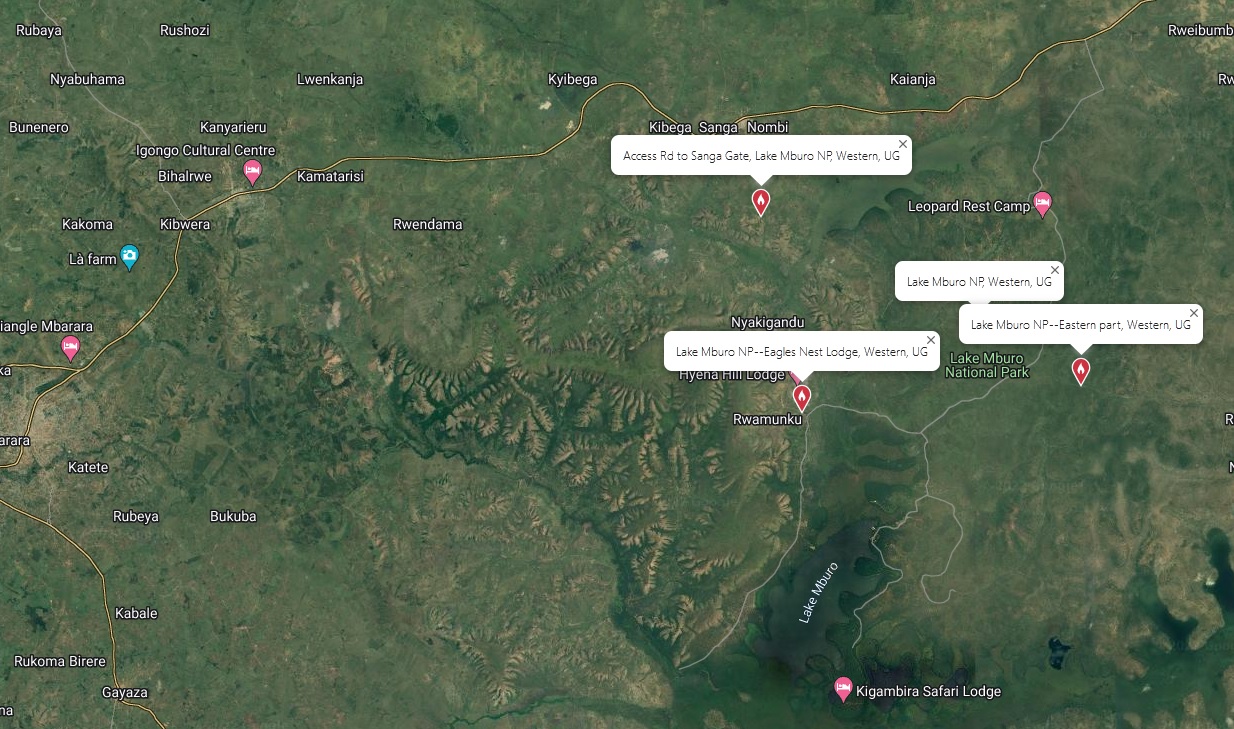
Mburo NP 4th July
We stayed on the top of a hill at Eagle Nest Lodge. They have tents and the back exit leads to a bathroom so you have to lock both sides with a padlock that is provided.
They also have banda's/cabins. The food was good and the view very nice overlooking the vast savannah of the park.
At dusk and dawn we would hear Freckled, Square Tailed and Black Shouldered Nightjars.
Potentially this park holds a few new birds for me.
Impala's were numerous and very confiding to vehicles so apparently no hunting there and the park is well guarded.
Nice views of Giraffes also confiding. The birding was a little hard.
I wanted to see the Red faced Barbet but we failed to find one despite a lot of trying. It seemed that the Black Collared Barbet is
the more dominant species and as soon as our tape would play the sound of Red Faced Barbet, the Black Collared Barbet would come in
and respond. The park is also known as a good site for Brown-chested Lapwing. But the beginning of July is just a little too early
for this species. We missed it.
A decent list of birds was seen though.
The boat ride was very rewarding with beautiful close views of African Finfoot, Goliath Heron and Rufous Bellied Heron.
Hippos and a few Nile Crocs in the lake.

And in the late afternoon we got the biggest surprise: a splendid adult male Pennant-winged Nightjar flying very close to us when the sun was not yet set.
Excellent views of this "out of this world" kind of bird.
Only two birds out of the 10.000+ dare to break the golden rule to mess with perfection when it comes to the design of a birds wing. This one does so in the most spectacular way.
A sensational and thrilling sight that will never be forgotten. It went right between my main targets when it comes to the top 5 birds even though I'd seen one before roosting in Kenya long time ago.
Mind that you have to be back out of the park at dusk. We delayed this a little and were not punished due to negotiations by Mr. Dauda and Abia.
It is possible to enter the park at night but this would be charged extra.
Since we heard nightjars from the lodge and hoped to see them on our way back. We were a little surprised we didn't encounter them.
Personal highlights besides the Pennant Winged Nightjar were: A confiding Black-bellied Bustard very close to our car and Tabora Cisticola.
Birds recorded:
https://ebird.org/checklist/S115270179
Next day we drove to our next site Mgahinga NP. We made a few stops on the way to try for the papyrus specialists.
We were most successful at Papyrus swamp (Nr Mabunu Market):
https://ebird.org/checklist/S115271311
Even at noon we still managed to excite a few birds by tape enough to get good views. White-winged Swamp Warbler was new to me
Mgahinga NP 6th July
We stayed at the Virunga Hotel in Kisoro.
This park in the very south west corner of Uganda is known to hold a few albertine rift valley endemics that are not easy to find elsewhere.
The most important for me were:
Rwenzori Turaco, Stuhlmans Sunbird, Regal Sunbird, Rwenzori Batis, Dusky Crimsonwing, Strange Weaver and Albertine Boubou
We also had great views of Kandts Waxbill, Archers Robinchat which were new to me.
We drove to the park in the early morning to make sure we had enough time to find the Turaco.

This bird usually is found at some distance from the entrance but we had glimpses of a bird soon after we went on our track.
The park is also known for the Mountain Gorilla and the Golden Monkey.
We found Rwenzori Turaco surpisingly after a walk of just 10 minutes but this was rather unusual according to the guide.
We later found more of them in their usual area. The bird is most frequently seen right after the bamboo zone.
Birds recorded:
https://ebird.org/checklist/S115299816
Bwindi Ruhija section (6-8 July)
This is the area were Grauer's Broadbill is found. It is also were Grauer's Swamp Warbler is found.
It holds a fair few of the specialities of Mgahinga NP as well. But not the Rwenzori Turaco as far as I know.
We stayed at the Broadbill Camp, very nice cabins with mosquito nets, although the cabins have double beds with one net.
I brought my own net for the separate bed. Very nice views over the rainforest.

It is situated on a ridge so when birding to find the specialities one has to go down a lot and the way back involves a lot of climbing.
The local guides here make effort to find nests of the Broadbill if it is the season. They have found out this is what birders come for to this section of the park.
In Uganda this is the only known area to find Grauer's Broadbill one of the most sought after birds of Africa and my main target after the Shoebill and the Pitta.
In the evening we heard African Woodowls very close to camp. And we could admire them not even leaving the area of the lodge.
We missed Doherty's Bushshrike at Mgahinga but found this beauty at an open section in the afternoon after playing the tape briefly when we heard the bird calling.
It is one of these Bushshrikes that is very shy and skulking.

Highlights were: Grauer's Broadbill, Doherty's Bushshrike, Tullberg's Woodpecker, Grauer's Swamp Warbler and Carruthers Cisticola.
This year the Broadbill was breeding again but in the first nest the young birds had already fled the nest. The guides found a second nest further down.
Make sure you get a guide who knows the sites. This seems a very tough bird to me when it is not breeding. It hardly calls and the call is not loud.
The bird is also small and not conspicuous. Our timing was near perfect.
July is reputedly prime time to see this bird and the Pitta but in hindsight June must be a good time too.
We found out this trip that we were almost too late to find these specialities. So this is something to bear in mind when planning this trip.
Birds recorded:
https://ebird.org/checklist/S115358657
In this area there is another speciality that we missed. Near the camp there is one of the best sites to find the Stripe Breasted Tit,
another Rwenzori speciality. We enjoyed birding in that area but found no signs of the Tit.
Birds seen:
https://ebird.org/checklist/S115358730
Along the road near Ruhija we had a few birds not seen anywhere else. Two new honeyguides were added to my list: Thick-billed Honeyguide, Dwarf Honeyguide
https://ebird.org/checklist/S115358913
Driving from Ruhija to Buhoma one passes a very bird rich area called "the neck". You should have a stop here and spend an hour or two.
It was very productive and is probably worth checking out more than once. Even in the heat of the early afternoon there was a lot of activity.
Our birds:
https://ebird.org/checklist/S115359023
Bwindi Buhoma section (8-10 July)
This is the most famous entrance of Bwindi NP. I was here 26 years ago when it looked very different.
The area where I pitched up my tent was now a healthy secondary rainforest area with quite a few birds.
The village had extended almost to where the park is starting.
They built a huge complex for Park Headquarters in the mean time and the community lodge is not the only place to stay near the park anymore.
The community lodge is now a high quality lodge with very good cabins and has a nice veranda where one can enjoy food or drinks while admiring the forest.
The village and local people are really gaining from the big money that comes in from Gorilla tracking.
This seemed one of those rare places where, by the looks of it, the forest had grown and not shrunk over time.
But the birding here was a lot harder than I remember from so long ago. Highlights were: Many coloured Bushshrike, Bar-tailed Trrogon, African Broadbill displaying and a pair of
Jameson's Antpeckers near the entrance.
It took the best of our guides and us to find the birds and we missed quite a few good ones like: Purple Breasted Sunbird, Grauer's Warbler and Neumann's Warbler.
Having said that I realise that I was there for a few more days that long ago so it is not that strange that we did not find all of the birds.
Birds Recorded:
https://ebird.org/checklist/S114726265
On our way to Kibale we stopped at a site that Abia knew to be productive near Kishunju school.
This gave us and even Abia a new mammal species: African Striped Weasel. And quite a few birds:
https://ebird.org/checklist/S115359282
Queen Elizabeth NP
The shortest way from Buhoma to Kibale leads through this park. We took it a bit slow to allow time for a few birds.
It is not very often one encounters 4 (critically) endangered species on a single day.
Besides the only vegetarian vulture (Palmnut Vulture) we saw the 4 species of the carnivorous vultures that are severely threatened and a few more species:
Ishasha sector:
https://ebird.org/checklist/S114726265
Mbasas bird area:
https://ebird.org/checklist/S115412203
Kibale Forest NP (10-12 July)
Park Headquarters are situated on the map where it says: "primate lodge". The main road back towards Fort Portal is good for birding. One can have a try
for White Spotted Flufftail near the bridge about halfway on the main road. A little further back towards Fort Portal there is a clearing where one could try for
White-naped Pigeon but we did not find it here trying 3 times.

26 years ago I spent about a week in this area enjoying birding just from the main road.
I remember a small wooden stall at the beginning of the forest on the Bigodi side. People were trying to make me pay 15 US$ for just walking on the main public road.
I thought that a bit much and not quite fitting in my budget so I usually passed the stall silently in the very early morning.
I then was not in the right time of the year to see the Pitta, didn't have a clue where to find it and did not know the sound it would make.
If I had heard it I would probably thought it was a frog of some sort. I then camped in the garden of the cook of the former ambassador of Rwanda.
I could not exactly find the same place again because things had changed in 26 years and a lot more places to stay had started in the meantime.
This forest is also the best place to spot Chimpanzee.
We now stayed at the Guereza Canopy Lodge and I was curious if we were going to stay in tree huts or so which would be adventurous but it turned out it was situated
on a small hill and it overlooked part of the canopy of the forest.
The lodge is a good spot to find the Sabine's Spinetail.
https://ebird.org/checklist/S115412497
https://ebird.org/checklist/S115412609
Food was not its best quality even though the staff were very concerned to be as hospitable as possible but it was acceptable and the owner seems to be a birder herself
and has a Swarovski Scope on the veranda overlooking the canopy. It seems a very nice place to stay for a birder.
Nearby we heard Black-shouldered Nightjar again and when we drove to our lodge from the main road one evening we decided to try the tape for it.
This gave us spectacular views of a male first almost attacking us and then kind of displaying close by in the torchlight.
This was near the Jungle lodge:
https://ebird.org/checklist/S115412921
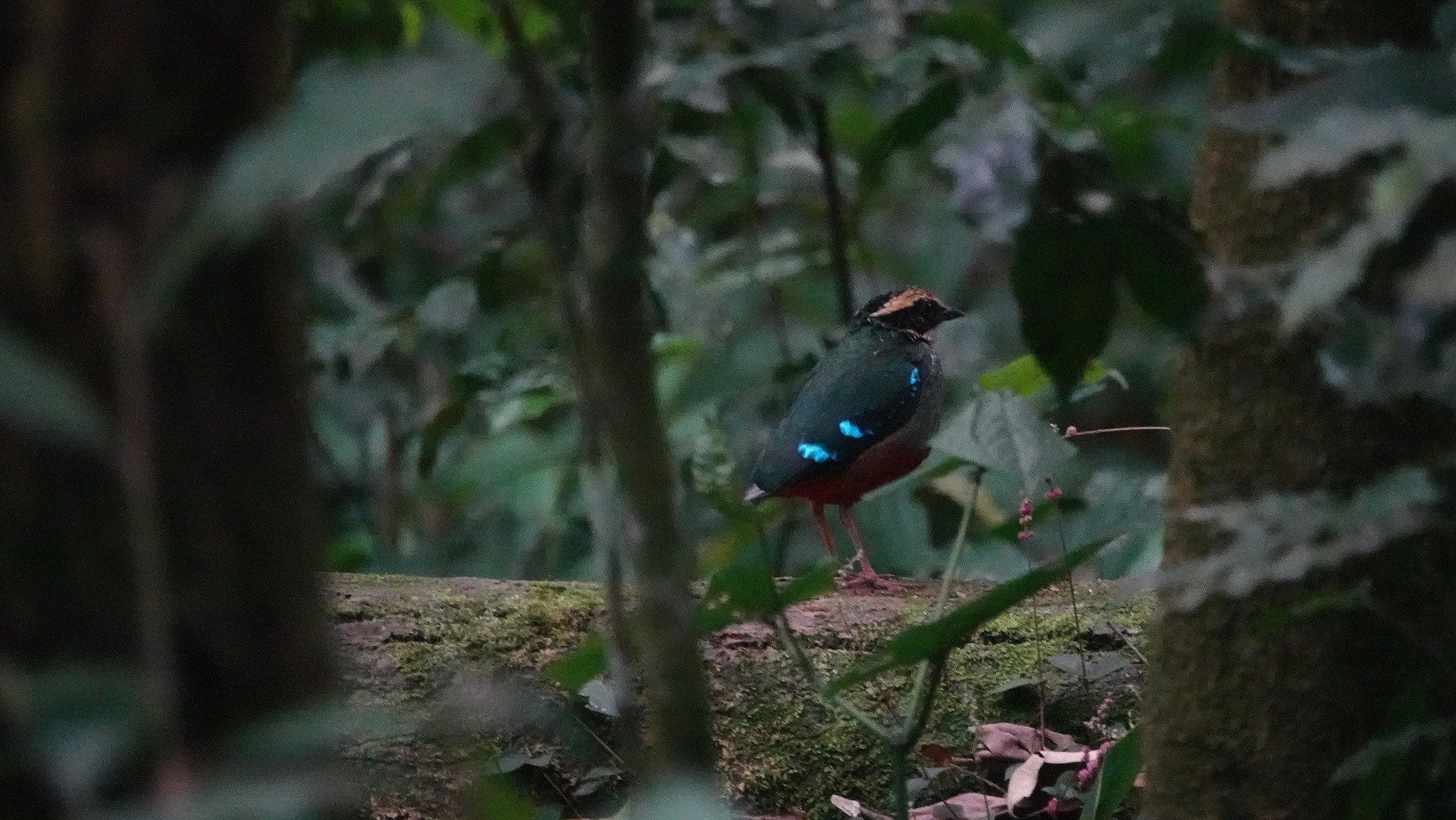
Kibale was the most important site for me as it holds the only known place to have a decent shot in finding Green Breasted Pitta.
As far as I knew July is one of the best months to see this hard to find bird. It is breeding time and birds have reported to be displaying in this month.
Displaying is usually done before sunrise in the dark. Most people do only hear the birds sitting in the canopy after the stop displaying the birds drop down and can then sometimes be found on the floor in the area where they were displaying but people have missed them after hearing them only.
This year turned out to be a little different. Justice our guide said that the birds had stopped displaying recently.
This was kind of ominous news to us but somehow he gave me the feeling that the fact that the birds stopped displaying is not really an issue for him.
Abia told him before the start: we want three birds: the Pitta, the Pitta and the Pitta.
And she was putting it quite accurate :-). So Justice made a plan and told us to drive back for some distance and take another road into the park.
Justice brought us straight to his best spot before dawn and we saw the birds almost immediately but not after telling us to wait just 1 minute,
any moment now a Blue Breasted Kingfisher will land on the path.
And there it was just seconds later. Just as to give you an impression how powerful local knowledge can be.
For Uganda I know this is certainly not an easy bird to see. One can however see this bird in many places in West Africa more easily.
Justice took us straight into the forest without even taking a path. He really seemed to know where he was going. Only few minutes later he stopped
and told us to scan the ground. We were thrilled to find our first Green Breasted Pitta. Beautiful as it was, the bird seemed not entirely at full colour.
We were looking at a young bird. But soon a parent came on the path just 3 metres away from us. An adult! When we looked further in the area we found another adult bird
feeding a young. So in all we saw 4 Green Breasted Pitta's. Other personal highlights were: Cassin's Hawkeagle
Birds recorded:
https://ebird.org/checklist/S115412585
In the afternoon we went to Bigodi Swamp.
Bigodi Swamp was already up and running as a birding destination 26 years ago. It then was a site for Papyrus Gonolek.
But the bird can be hard to find there now because of a lot of tape use. So Abi gave us another chance at a site on our road from Mbamba Swamp to Mburo NP.
We had already seen the bird and could focus on a few other birds like Shining Blue Kingfisher, White spotted Flufftail etc.
https://ebird.org/checklist/S115412711
The area near the bridge seemed very good for butterflies so I took some time to take a few pictures.


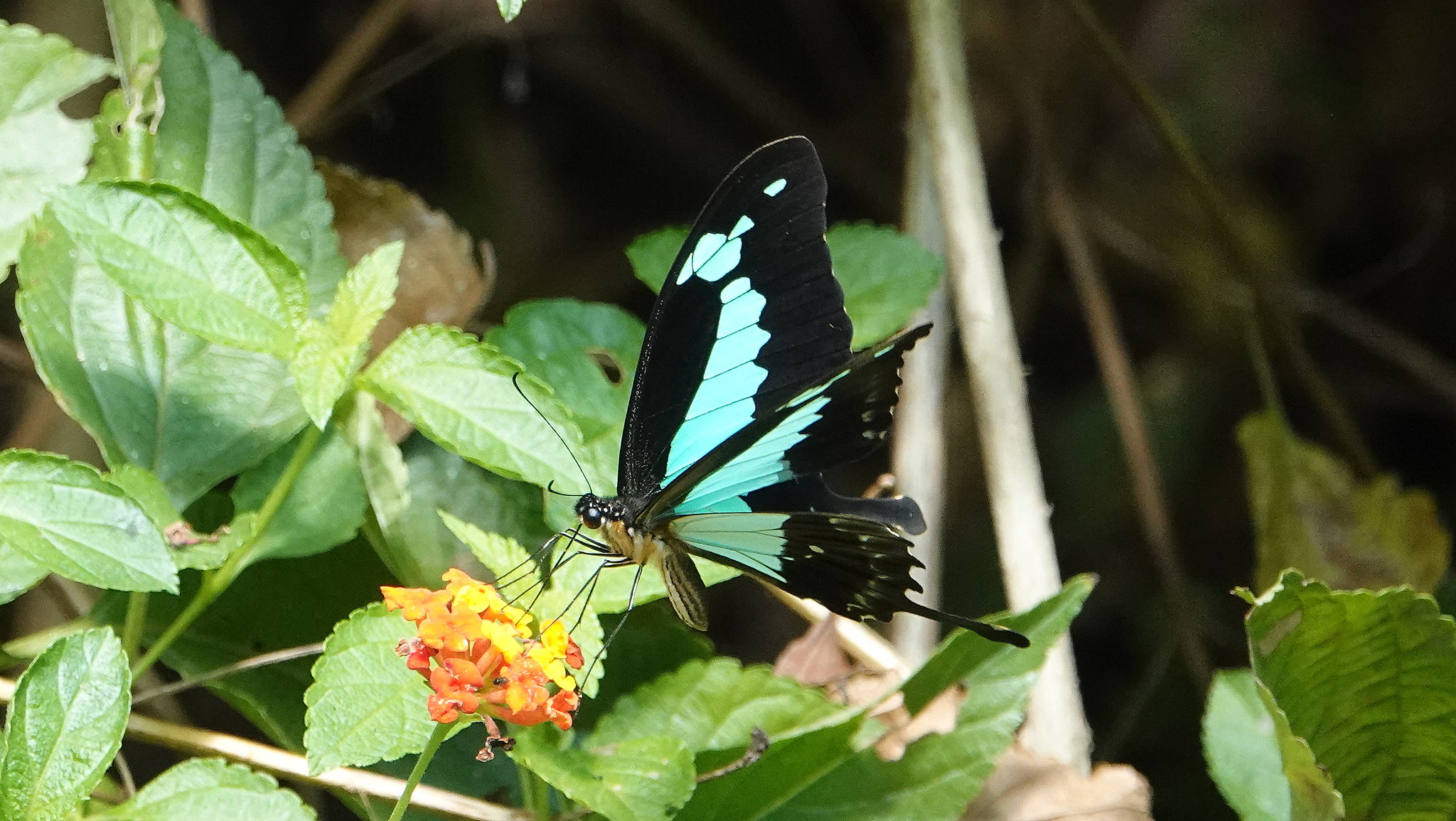

Next morning we birded along the main road through Kibale Forest:
https://ebird.org/checklist/S115413227
Semuliki NP (12-15 July)
We stayed at "Banda's and campsite" not far from Park Headquarters situated near the boardwalk to the 2 hotsprings. See below link for the map:

The place has nice banda's with mosquito nets, good food, very friendly and helpful staff and quite reliable electricity to charge your batteries.
It also has cold drinks and a nice veranda to relax and celebrate your new birds with a beer.
But it is a remote place so it seems you should not turn up just like that and surprise people.
Honeyguide Greenbul, African Woodowl in the area as well as a few other good birds.
Among others:
https://ebird.org/checklist/S115463540
Semuliki is also mainly primary rainforest and holds a lot of species not found anywhere else in Uganda. It seems more than any other national park the link from East to West Africa as far
as the birdlife is concerned. Quite a few West African specialities of Uganda are seen here only.
A few I'd like to mention are:
Hartlaubs Duck, Red-billed Dwarf Hornbill, Yellow throated Nicator, Yellow throated Cuckoo.
These were seen except for the Duck which requires a long walk to a very small area of water that is totally enclosed by rainforest and with the duck being shy and the views limited this does not seem
like a site which will give you an excellent chance. We missed it in two attempts and so did others.
The list of specialities of this park is much longer. The place should be included in your itinerary.
I lived in West Africa for a period of time and visited 5 countries there in total 3 years, so had seen a fair bit of the West African birds but still got a few new birds here.
We had Alex as a guide. Unfortunately he was the only guide available and there was a group of Swedish birders that also needed a guide. So we went in with approx. 9 people.
Rainforest birding in these large groups is kind of problematic. The good viewpoints are often very local and it takes time for all the birders to see the bird if it allows for several minutes which is usually not the case.
Alex proved to be an excellent guide.
Just an example of how good he was:
When we were walking at a decent pace to try to get early enough to a site for the duck, he would suddenly stop, turn around 180 degrees and point out a Rufous bellied Helmet Shrike
within just two seconds. A very good bird that I remember seeing only in Gabon once. He later said he heard the distinctive wingbeat (we didn't hear a thing..).
It was one of those typical instances of the power of very local knowledge.
The Swedes notices this and said to him: you must have eyes in the back of your head.
Some personal highlights were: Grant's Bluebill, Yellow footed Flycatcher.
Birds recorded:
https://ebird.org/checklist/S115439457
There is a natural and large open area with low vegetation created by vulcanic activity near the park headquarters. This allows for some distance and overview of the area.
Our first visit gave us nice views of Forest Robin.
In the evenings this is a good area to try and spot the White-naped Pigeon which was on my wanted list.
We tried this several times and saw lots of pigeons flying around all of them were African Green Pigeons and a few Rameron Pigeons.
This place also allows views of the pretty De Brazza's Monkey.
Birds:
https://ebird.org/checklist/S115463479
At one of these mornings we had a small group of mystery ducks flying over, very much obstructed by all the trees.
Me and Stephen could not make out what they were. Someone was suggesting Whistling Ducks but they certainly were not these species.
Not by sound and not by the looks of it. Abia later suggested Egyptian Goose. But the same was true there:
They were not these species neither by sound nor by looks. I saw dark brown bodies and blackish heads.
They could have been Yellow billed Ducks or they could have been Hartlaubs Ducks but Alex and about 9 other birders
were also watching them and Alex would have recognised his Duck being the excellent birder he appeared to be (and knowing it is a speciality). So these ducks are still a mystery.
In the evening we went out to see Bates Nightjar. I heard one call in the evening once. I'd seen it before in Gabon.
We went out and found a Lord Derby's Anomalure (Flying Squirrel).
After this main site we headed back to Entebbe and our Airport Link Hotel that had "the magic tree" in the garden.
Still visited by many species. In a short time 6 Meyer's Parrots, 2 Double Toothed Barbets, 1 Broadbilled Roller and an African Hobby visited this tree with no leaves.
https://ebird.org/checklist/S115150602
We spent a few hours in Entebbe Botanical Gardens, which indeed offers a good introduction to a couple of species.
https://ebird.org/checklist/S115159450
This trip a total of 444 species were observed during this trip.
Needless to say that we were both not aiming to see as many birds as possible but to make sure we would see the main target birds.
We also saw approx. 30 species mammals of this trip. Reptiles were few. A turtle/tortoise was seen in Queen Elizabeth NP.
A Spotted Bush Snake in a tree and two species of Skinks. And the sometimes beautifully coloured Agama:

In the two Covid years I found myself more interested in butterflies and I was very often distracted by huge colourful butterflies flying around when everyone was
frantically looking for birds I was often following these beauties hoping they would sit down, which they usually would not do.
To get an impression of the whole trip you can have a look at my photo's:
Uganda 2022 | Flickr
Many thanks to Stephen for meticulously recording all birds and entering as much as possible as complete checklists at most of the many locations visited.
This allows for a more profound statistical analysis for any visitor going to these places.
Here is the total checklist:
https://ebird.org/tripreport/67917?view=species
Makanaga Swamp (17th July)
After this trip I went for a tiny extension to visit Makanaga Swamp which is also know for it's Shoebills. It is probably even better for this bird but is a little further and far less well visited.
This produced a few more species.
If you feel that only a short boat trip to see the Shoebill is not enough I'd recommend going there. It is a much wider area with more open water that helds more species and also more Shoebills.
Makanaga is situated in Mpigi District. It takes one and half hours drive from Kampala and Entebbe to get there.
To get there, you drive along the Kampala-Masaka highway to Kamengo town in Mpigi District. This is about one and half hour drive depending on the traffic condition on the road.
In Kamengo, turn off at Butoolo and drive for about 15 minutes to 20 minutes to Namugobo landing site.
I was hoping for Dwarf Bittern and/or Lesser Moorhen both birds still missing on my African list.
I did not find those but the trip was rewarding. Because of my aim to see the Moorhen this produced a lot of Black Crakes.
Confusingly a soundrecords of the Lesser Moorhen on the internet that Abia used seemed also to be of Black Crake.

Slender Billed Gull (a couple of birds in Breeding plumage but on migration, I know this species from West Africa to migrate in Breeding plumage), Whiskered Tern, Gull Billed Tern and
Spur Winged Goose, African Pygmy Goose, Levaillants Cuckoo were a few birds that I can not remember seeing at Mbamba Swamp or anywhere this trip. I'd seen them before quite a few times though.
4 Shoebill were seen (Abia had counted 8 here in the past on a single boat trip). There are usually more Shoebill found here than in Mbamba Swamp.
This place is probably better than Mbamba Swamp that is really heavily visited. It also allows for a wider range to be searched.
Mbamba is more vegetated making it less accessible to look for different places.

The same day I sadly had to take my plane home. . .